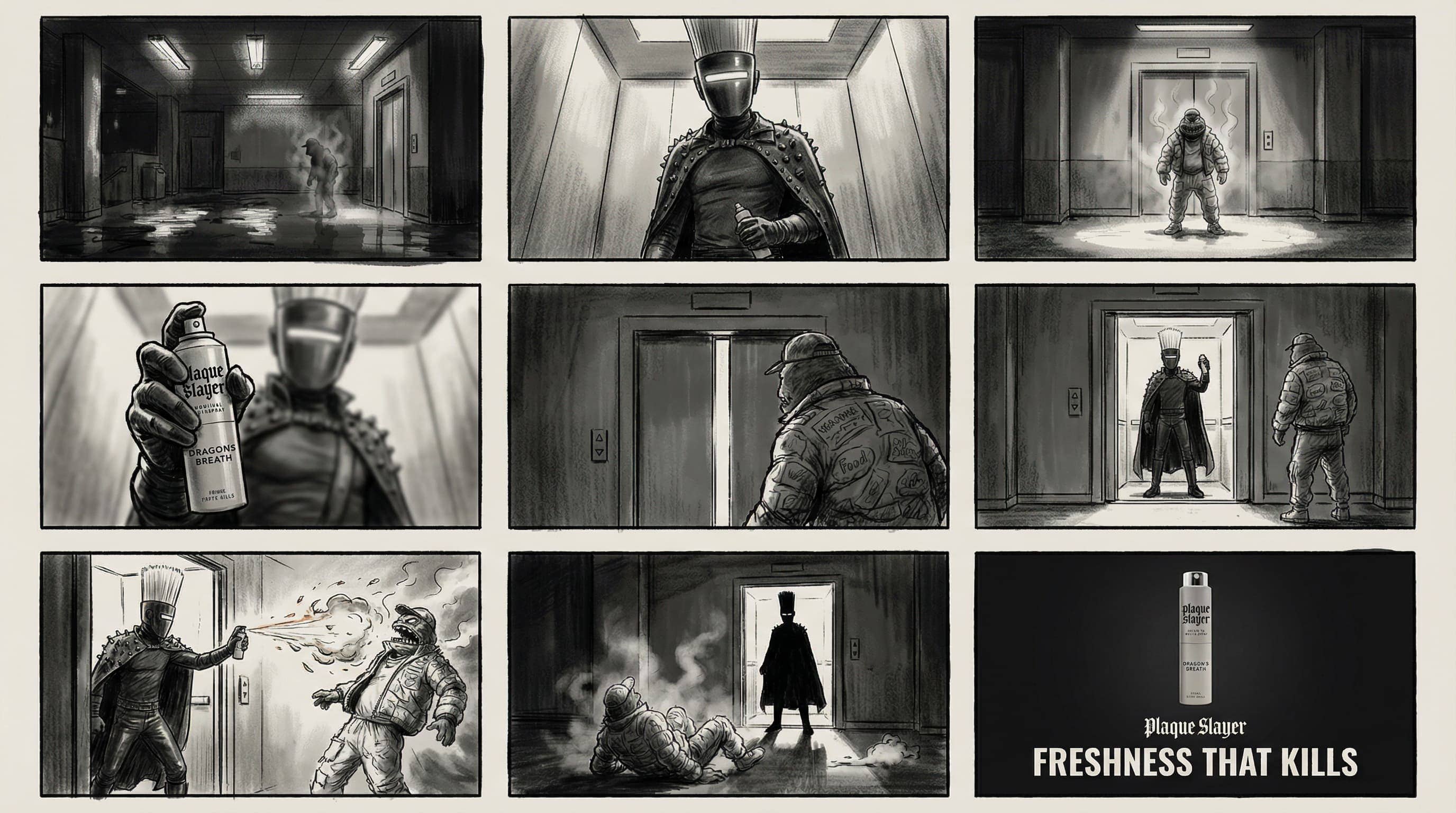
"Does the storyboard cover all eight essentials (narrative flow, visuals, narrative speech bubble, tagline) in a way that could guide production?"

This test case passes. The storyboard successfully adheres to the creative brief by maintaining intended narrative continuity and utilizing cinematic, film-like framing that enhances the visual impact of each panel. The product is rendered with consistent monochrome fidelity and clear label readability, ensuring the brand remains the focal point through the escalation and payoff phases, ending with a professional end card. While there is room for improvement in environmental consistency—specifically the shifting placement of the elevator buttons—the output is fully suitable for real-world use without manual correction. Its strong structural flow and clear communication of the campaign's theme and tagline make it a highly effective asset for the summer launch.
Red: Not supported; Green: Supported
Primary deliverable: High-res image master (TIFF)
• Master: 16-bit TIFF, Adobe RGB; non-destructive retouching; layered PSD as source
• Web: sRGB JPG (quality 80–90) or PNG for transparency; 2000px long edge unless specified
• Crops: provide common aspect ratios (1:1, 4:5, 16:9, 9:16) with safe copy area
Create a 16:9 storyboard (9 panels) ad featuring King Bristle and Hench Stench in an “Elevator Showdown.” Style must be cinematic and film-framed: strong composition, clear focal hierarchy, dramatic low-key lighting, deep blacks and controlled highlights. Use movie-like framing cues per panel (wide/medium/close, over-shoulder, low angle, shallow depth of field, negative space). IMPORTANT: King Bristle starts inside the elevator and stays inside until the doors open; Hench Stench is waiting outside in the elevator lobby/on the floor and must NOT appear inside the elevator until the doors open.
Panel 1 (Establishing wide): Wide cinematic establishing shot of a dim, gritty elevator lobby at night, empty and tense. Elevator doors centered in frame, harsh overhead fluorescents with some flicker, deep shadows, wet floor reflections, signage soft and unreadable. Hench Stench stands far in the background near the elevator area as a faint silhouette with a very subtle haze around him, waiting.
Panel 2 (Inside elevator medium): Cut to inside the elevator, medium shot on King Bristle framed slightly off-center, low angle for power. He’s calm, visor glow faint, shoulders squared. One hand rests near his Dragon’s Breath mouth spray at his side (product not fully revealed yet). Claustrophobic elevator walls, dim practical ceiling light, deep black corners.
Panel 3 (Lobby POV toward doors): Back to the lobby, medium-long shot facing the closed elevator doors. Hench Stench is now closer, clearly waiting directly in front of the doors, still outside. Emphasize distance and threat: he stands in the pool of light, the rest of the lobby falls into darkness. Add a barely-there “stink” haze that stays subtle and grounded.
Panel 4 (Elevator interior close-up): Inside elevator, tight close-up on King Bristle’s gloved hand moving to grip the mouth spray—monochrome can with readable label detail, lit by a sharp rim highlight. The rest of his body is out of focus; use shallow depth of field and dramatic contrast.
Panel 5 (Doors about to open, split tension): Over-the-shoulder shot from behind Hench Stench in the lobby looking at the elevator doors as they begin to separate slightly (a thin line of light appears). Hench Stench leans forward, anticipating. Keep him clearly outside. Cinematic framing with strong leading lines from corridor to doors.
Panel 6 (Door opening reveal, hero vs villain): As the elevator doors open, medium-wide hero shot from inside the elevator looking outward: King Bristle stands in the doorway framed by the elevator interior, Hench Stench stands outside in the lobby. Strong contrast between the elevator’s interior light and the lobby shadows. King Bristle raises the mouth spray to chest level, label readable.
Panel 7 (Action beat, breath weapon): Dynamic three-quarter angle from the lobby side: King Bristle remains planted inside the elevator doorway and uses the mouth spray, then “weaponizes” his breath into a controlled red/orange energy/flame-like burst that shoots outward into the lobby. Keep the burst bright stylized but believable: tight cone, clean edges, embers, heat shimmer, no giant fireball. Hench Stench recoils outside in the lobby as the wave hits him; the stink haze breaks apart. King Bristle stays inside the elevator.
Panel 8 (Aftermath, villain defeated outside): Low angle on the lobby floor looking back toward the elevator: Hench Stench is down/defeated on the lobby floor outside the elevator (not inside), fading haze dissipating. In the background, King Bristle stands tall in the elevator doorway, dominant silhouette, embers drifting in the air, lobby lights flickering like they were disturbed by the impact.
Panel 9 (End card, clean product + brand): Minimal premium end card: dark charcoal/black background with subtle ember specks. Center the Dragon’s Breath mouth spray as a clean hero product shot in monochrome/black-and-white with label sharp and readable. Add the Plaque Slayer logo clearly and the tagline “FRESHNESS THAT KILLS” in large condensed-bold uppercase, white, high contrast, with safe margins and clean spacing. No other text, no clutter.
Loose cinematic storyboard illustration style.
Hand-drawn sketch lines with visible strokes.
Black and white only — no color.
Strong contrast using ink, graphite, or charcoal-style shading.
Rough tonal blocking and directional lighting indicated through shadow.
Stylized but readable characters and environments based on attached references.
Concept art / pre-visualization look.
Energetic, expressive, slightly rough drawing quality.
No color rendering, no painterly color shading, no colored lighting effects.
Clean grid layout (9 panels).
Panels separated clearly.
Readable framing variety (wide, medium, close-up).
Optional simple arrows or motion lines.
Neutral light background for the storyboard sheet.