Does the output deliver a brand-aligned, execution-ready marketing calendar that fully covers all seven sections—Campaign & Content Overview, Timeline & Scheduling, Channel & Distribution Plan, Ownership & Responsibilities, Resources & Assets, Performance Tracking & KPIs, and Flexibility & Notes?

This test case passes. The output provides a detailed marketing calendar encompassing a broad scope of activities, with tasks effectively distributed across multiple teams to ensure organized planning. There is room for improvement in the depth of specific sections, as the descriptions of marketing activities are quite brief, and areas such as Performance Tracking, KPIs, and the Channel & Distribution Plan would benefit from more granular detail. However, the output remains suitable for real-world use without manual correction because it suggests a diverse range of activities with logically spaced timelines, ensuring that project deadlines are plausible and actionable for all teams involved.
Red: Not supported; Green: Supported
Primary deliverable: Data analysis workbook (.xlsx)
• Format: Microsoft Excel Workbook (.xlsx), no macros (no .xlsm); compatible with Excel 2019+ and Google Sheets
• Structure (tabs): README, Data_Raw (immutable), Data_Clean, Analysis, Charts, Outputs, Assumptions, QA_Log
• Tables: Excel Tables for all datasets; consistent column headers; frozen header row; filters enabled
• Data types: ISO dates (YYYY-MM-DD); currency columns formatted to campaign currency; units stated in headers; no merged cells in data tables
• Calculations: formulas only; named ranges for key inputs; clear cell comments for assumptions
• Visuals: charts embedded + editable; axes/units labeled; export-ready chart sizing for slides (16:9-friendly)
• QA: row-count checks; missing-value flags; outlier checks; reconciliation vs source totals; version + timestamp in README
• File size limit: ≤ 25MB; external links disabled; all data embedded
Create an execution‑ready marketing calendar for the launch of Plaque Slayer’s Dragon’s Breath campaign. The calendar should cover a full campaign cycle and reflect the touchpoints and priorities defined in the central brief.
The calendar must be granular and in table format. It should include the following sections:
Campaign & Content Overview (outside the table)
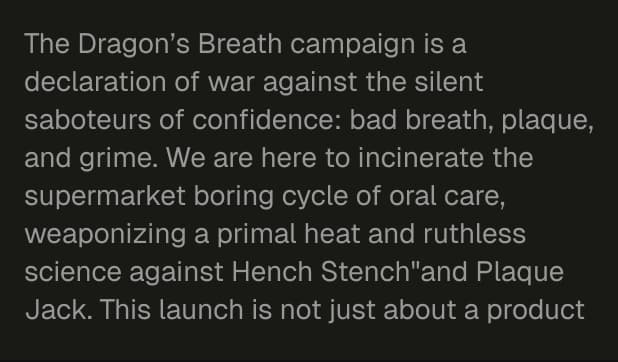
Summarize the Dragon’s Breath launch campaign, including its mission to disrupt the “supermarket boring” cycle, weaponize confidence, name the villains (Hench Stench and Plaque Jack), and dominate static, social, video, and e‑commerce touchpoints.
Timeline & Scheduling
Provide a week‑by‑week breakdown of campaign activities across the full campaign period.
Channel & Distribution Plan
Use only the channels defined in the brief:
- Static/social
- Video/social
- E‑commerce (Amazon PDP and similar retail environments)
Ownership & Responsibilities
Define roles and responsibilities for executing the campaign (do not invent names; structure by function only).
Resources & Assets
List the creative assets required across static, social, video, and e‑commerce.
Performance Tracking & KPIs
Define how campaign performance should be measured across awareness, engagement, conversion, and competitive differentiation.
Flexibility & Notes
Include considerations for adapting the calendar based on performance or platform dynamics.
Dragon’s Breath Details
- Experience: Heat‑activated clean with microdose chili warmth and juicy orange‑guava punch.
- Science: Capsicum extract for heat; citrus terpenes to hunt and remove odors; nano‑hydroxyapatite complex for enamel armor.
- Formats: Refillable toothpaste; instant‑action mouth spray.
- Best For: All‑night partying; all‑day hustling; eliminating “Dragon Breath” after cocktails, tacos, or midnight snacks.
Refer to brief as attached for context and more details